

Go for Loop
In programming, a loop is used to repeat a block of code. For example,
If we want to print a statement 100 times, instead of writing the same print statement 100 times, we can use a loop to execute the same code 100 times.
This is just a simple example; we use for loops to clean and simplify complex programs.
Golang for loop
In Golang, we use the for loop to repeat a block of code until the specified condition is met.
Here's the syntax of the for loop in Golang.
Here,
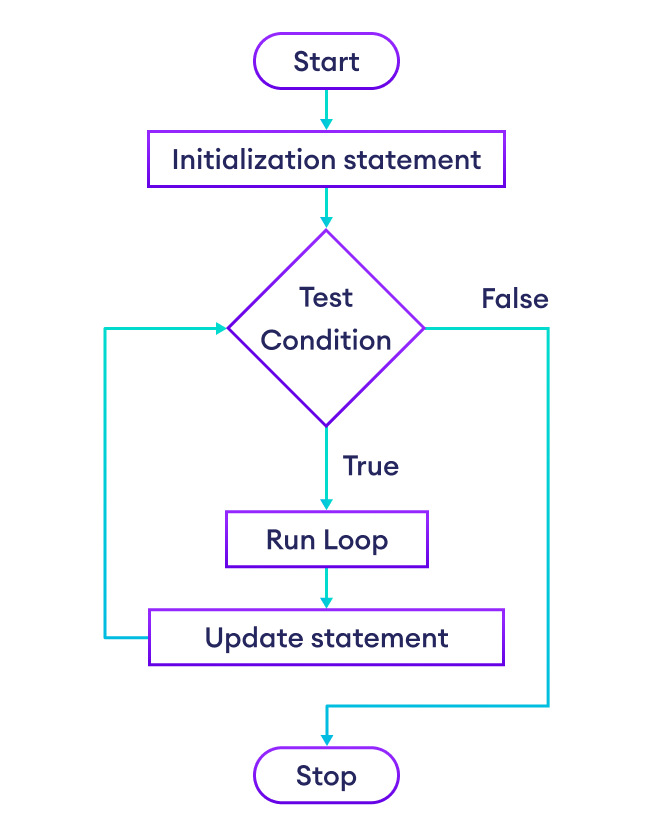
- The initialization initializes and/or declares variables and is executed only once.
- Then, the condition is evaluated. If the condition is
true, the body of the for loop is executed. - The update updates the value of initialization.
- The condition is evaluated again. The process continues until the condition is
false. - If the condition is
false, the for loop ends.
Working of for loop
Example 1: Golang for loop
Output
Here is how this program works.
| Iteration | Variable | Condition: i | Action |
|---|---|---|---|
| 1st | i = 1 | true | 1 is printed. i is increased to 2 |
| 2nd | i = 2 | true | 2 is printed. i is increased to 3 |
| 3rd | i = 3 | true | 3 is printed. i is increased to 4 |
| 4th | i = 4 | true | 4 is printed. i is increased to 5 |
| 5th | i = 5 | true | 5 is printed. i is increased to 6 |
| 6th | i = 6 | false | The loop is terminated. |
Example 2: Golang for loop
Output
Here, we have used a for loop to iterate from i equal to 1 to 10.
In each iteration of the loop, we have added the value of i to the sum variable.
ON THIS PAGE